← Back to The Studio

Extra

Illustrated Edition

An Illustrated Chronicle of Games & Adventure

The Leclezio Gazette

Devoted to Strategy, Mystery, Exploration & the Art of Play

Thirteen

Games of Adventure

Vol. I.

New York, Tuesday, October 6, 2026

Special Edition

A City to Buy.
Seven Worlds to Escape.

Inside Richard Leclezio's collection of thirteen games, where a sealed bid, a borrowed hour and a beam of light can change the outcome.
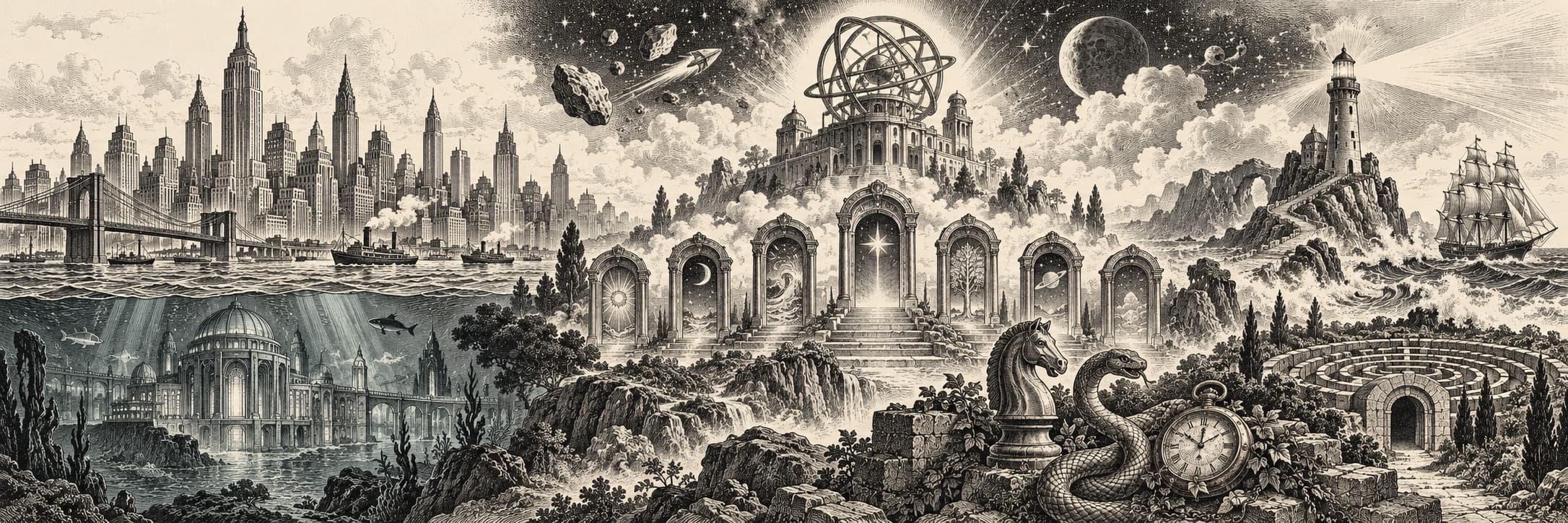
A World of Possibilities — original editorial illustration inspired by the collection

A World of Possibilities

Original editorial illustration inspired by the collection; not a gameplay screenshot.

♦ ♦ ♦

From Our Amusements Desk

Thirteen ways to make your next move

New York. Somewhere beneath the Pacific, the lights have come on in a station the ocean claimed in 1936. On another screen, a property investor weighs a sealed offer. Elsewhere, a lighthouse keeper has three minutes to bring three vessels home.

These are the opening invitations in Richard Leclezio's game collection: thirteen titles stretching from a crossword chessboard to the edge of a simulated fusion plasma. Seven belong to one escape-room anthology. Six take their own routes through strategy, combat, rescue and experiment.

The range is striking, but a recurring idea connects it. The player is given something to operate: a ship, a light, a map, a machine, a property business. Progress comes from learning what that instrument can do, then deciding when to act.

The Art of Play

The pleasure of a difficult choice

An asteroid field supplies ammunition. An atlas rearranges islands and channels. A chess piece carries a letter and a tactical purpose. Across the collection, familiar objects invite unfamiliar decisions.

The pressure changes with the setting. Air Rights allows three actions each quarter. Marrow Sound compresses its rescue into three minutes. Twenty Milliseconds changes the speed of its simulation to reveal how difficult a quick correction can become.

The escape rooms offer a quieter rhythm. Their worlds wait while the player studies a mechanism and tests an idea. A repaired machine or a redirected beam of light becomes evidence that a place is beginning to make sense.

Serpent's Gambit turns movement into a calculation about letters, points and the safety of the king. Labrys makes exploration a wager: a detour may supply the means to survive the next encounter.

Turn the page for the seven escape rooms.

Property & Power

Air Rights
New York is on the table

A portfolio, two rivals and the cost of wanting one more building.

The opening stake is $24 million. The objective is to build the strongest property firm in the city. With three actions per quarter, the investor must decide what deserves attention: research, an acquisition, a lease, an improvement or a negotiation.

The short campaign runs for twelve quarters and asks for $38 million in equity and first place. The longer campaign offers twenty-four properties over twenty-four quarters, with a $60 million equity target and the same demand to beat both rivals.

Debt, auctions and development make each opportunity a question of timing. The guided first deal offers a way in; the visible victory target supplies a reason to keep going. The skyline is the setting, but the real drama is the next commitment of cash.

Visit the Air Rights playing room

Illustrated Games Supplement / 6 October 2026

The Leclezio Gazette

The Escape Room Serial / Chapters I–VII

An Anthology of Impossible Places

Seven Doors. No Ordinary Way Out.

From the deep ocean to the last eclipse, each chapter gives curiosity a different job.

Each game stands on its own. Follow the sequence or begin with the world that calls to you. The anthology has no countdown, and progress is saved separately for each chapter in your browser.

♦ ♦ ♦
IThe Deep

The Ninth Tide

A station wakes beneath the Pacific.

At 840 metres below the surface, an Art Deco station lost in 1936 is waiting to be understood. Alma's voice leads the player through three connected chambers, restoring machinery and piecing together a forgotten story. The Echo Lens and interconnected mechanisms turn observation into progress. Yet the final task reaches beyond opening a door: decide what deserves to return to the surface. The first chapter sets the series' tone — patient, mechanical and personal.

IIThe Railway

The Last Departure

A train outside time needs a route home.

An Alpine train carries the next mystery. Its carriages can be rearranged, making the train itself part of the puzzle. Six carriage arrangements and six puzzles ask the player to think about connections, sequence and the consequences of moving a room. The railway setting gives the story a natural question: what does it mean to depart, and what might a second chance require? Two endings let the final choice matter as much as the solved machinery.

IIIThe Sky

The Glass Meridian

In this observatory, light does the work.

The third chapter rises into a sunlit cloud observatory. Mirrors and coloured light become tools for opening the way through three chambers and six mechanisms. A living seed gives the apparatus something fragile to protect. This is a mystery of alignment and growth. The player studies what a beam reaches, what interrupts it and what changes when it is redirected. The theme of letting something grow carries through to a choice between two endings.

♦ ♦ ♦
IVThe House

The House of Borrowed Hours

One address. Three moments in its life.

The years are 1926, 1976 and 2026. The house is the same, but its rooms carry the results of what happened before. Repairing the past can change the future, including the routes available to escape. Time becomes a practical puzzle mechanism: inspect an effect, trace a cause, then return to see what your intervention changed. Synchronising the timelines leads toward two endings. Here, the key to a locked room may be an action taken decades earlier.

VThe Archipelago

The Atlas of Impossible Tides

The map can change the territory.

An interactive atlas rearranges islands and channels while the tides reveal or conceal what lies below. The player must expose a drowned archive, find a crossing to an inland lighthouse and work through the mystery of its Fresnel lens. Cartography becomes an act of intervention. Instead of merely following a map, the player changes what the map makes possible. The chapter links its shifting geography to a story about belonging, with two ways to bring the journey to a close.

VIThe Stage

The Theatre of Unwritten Names

The scenery has a part to play.

Revolving sets, counterweights and shadows turn a theatre into a working puzzle box. The player must understand the machinery of the stage and bring the pieces together for a final rehearsal. The story considers identity and the names through which people are remembered. A scene can be moved; a shadow can be changed; a role can be reconsidered. Its two endings carry that question beyond the footlights: which story should finally be told?

♦ ♦ ♦

VII / The Final Chapter

The Observatory at the End of Everything

A lens. A ticket. A prism. A key. A compass. A name. Six earlier worlds return as clues in a celestial observatory. Operate its engine, hold the last eclipse and help the keeper leave. The finale supplies the clues you need even without earlier saves, bringing the anthology to a final choice between two endings. After so many impossible places, its most affecting image may be an ordinary door opening onto a sunlit garden.

Enter the complete seven-chapter series

Illustrated Games Supplement / 6 October 2026

The Leclezio Gazette

The Amusements Desk / Five More Ways to Play

Arcade / Strategy / Exploration / Rescue / Science

Nerve. Wits. One More Try.

Beyond the seven doors, the collection changes pace — and changes the rules.

♦ ♦ ♦

The Orbital Arcade

Asteroids: Event Horizon

The asteroid belt becomes your ammunition.

Full 360-degree rotation and thrust preserve the old arcade pleasure of learning to move through inertia. The Gravity Edition adds a sharper idea: hold the gravity sling to capture asteroids, then release them as a weapon. Twin pulse, scatter cannon and rail lance offer different approaches to combat. Meteor storms, crystal recovery, gravity tides and elite wardens lead toward the World Eater encounter. Survival depends on reading the space around the ship as well as firing into it. A hazard in the right orbit becomes an opportunity.

Enter the playing room

The Impossible Table

Serpent's Gambit

Chess, crosswords and a board full of surprises.

In the Obsidian Collection, every piece carries a letter. Moving onto the right crossword square writes that letter and earns points. The aim is to reach twenty-five points or capture the opposing king. Chess officers share the board with draughts, snakes and ladders. Captured pieces usually return home to rest for a turn; the king is the decisive exception. With 120 boards, three computer opponents, a daily challenge and local two-player play, it is a contest in which a good word and a good move may be the same thing.

Enter the playing room

Notice to Pilots

Turn. Drift. Capture. Release.

The asteroid belt is your ammunition.

At the Gambit Table

Twenty-Five Points Wins

Or capture the opposing king.

♦ ♦ ♦

The Five Gates

Labrys

Find the seals. Survive the journey. Reach the surface.

Five underground realms stand between the player and escape. Each asks for three seals, with monsters, ladders and hidden chambers complicating the search. Axe combat and dodging provide one answer to danger; hiding offers another. The appeal lies in choosing when to explore and when to push onward. A secret chamber may offer healing or a stronger axe, making a detour worth the risk. The labyrinth is more than a route to memorise: it is a place to read, survive and gradually make sense of.

Enter the playing room

The North Atlantic Watch

Marrow Sound: The Last Light

The keeper is down. Three vessels are still out.

It is October 14, 1893, in the game's storm-bound North Atlantic. A falling glass and a rising sea set the scene. The player inherits the lighthouse and a simple responsibility: bring the vessels home. Aim the light, stop their drift and guide all three through a three-minute watch. The compact time limit gives every correction weight. The lighthouse is both the instrument and the entire premise: a point of guidance in a sea that will not hold still. Headphones are recommended for this watch.

Enter the playing room

Five Realms. Three Seals in Each.

One Lighthouse. One Three-Minute Watch.

♦ ♦ ♦

The Experiment

Twenty Milliseconds

How much control can you keep when the clock speeds up?

The player adjusts heating and plasma shape, earning a higher score by raising pressure while staying below a changing stability limit. A shot lasts six simulated seconds. Start at one-tenth speed, try real time, then hand control to a rule that acts every twenty milliseconds.

The comparison is the point. The game makes response time something you can feel in your hands. Its plasma is a deliberately simplified educational model with a scripted limit and perfect forecast; the score is a pressure-time proxy, not a measurement of fusion power.

Also from the Training Desk

AI War Room: Black Swan Event

A related playable simulation within AI Command Academy puts scored crisis decisions into an executive training setting. It sits beside the thirteen-game collection as a reminder that rehearsal can be a form of play.

Editor's Note / A commemorative feature covering the game collection as documented on 6 October 2026. Descriptions reflect the available game records; this is not independent press coverage or a claim of commercial release.

Illustrated Games Supplement / 6 October 2026

Download PDF Edition