TalentOracle: The Underwriting of Human Capital
Why the $1.2M departure cost is a latency problem — and how six AI agents predict it 90 days before it happens, from resume text alone.
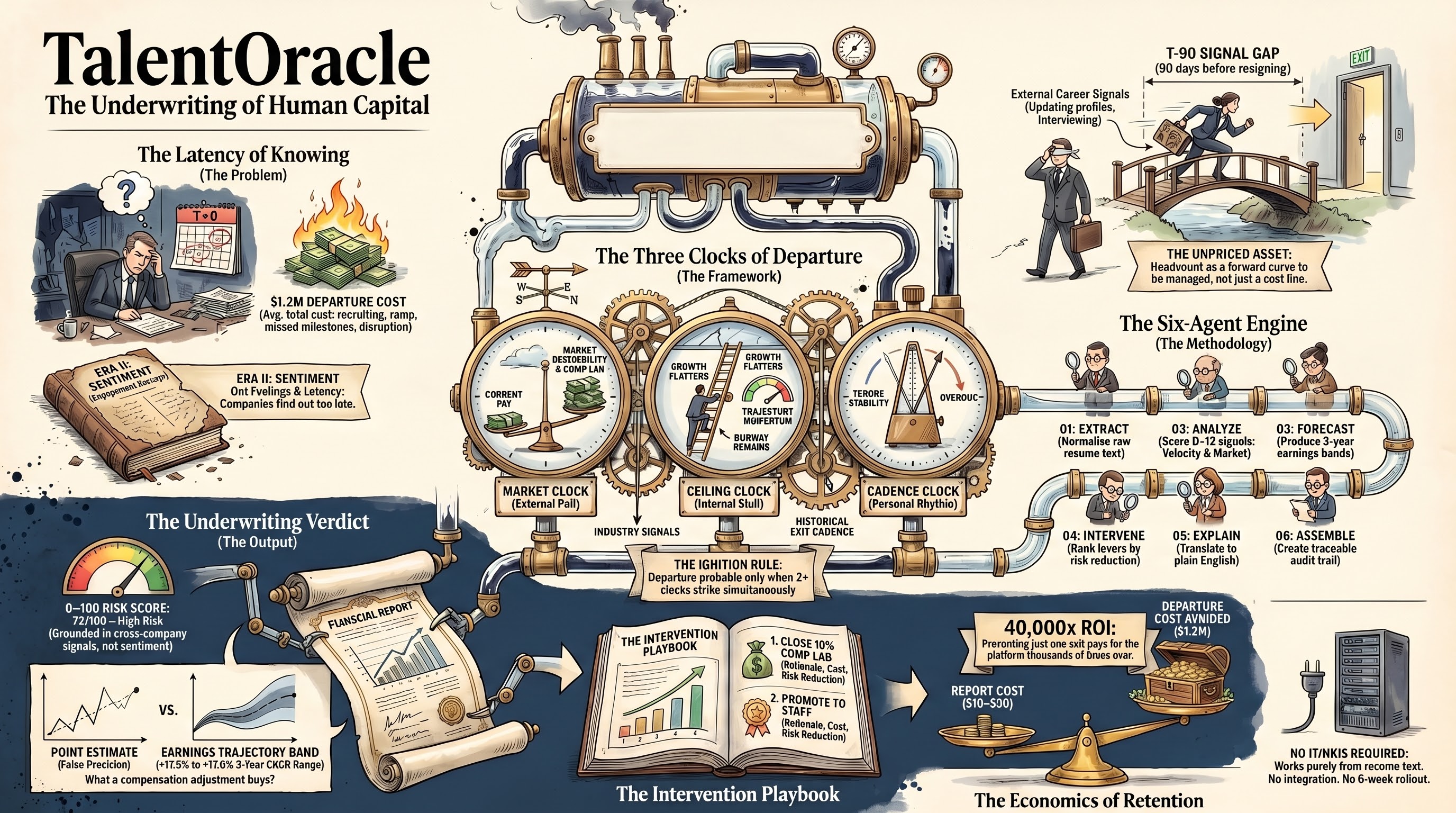
“Companies don't lose employees suddenly. They lose them 90 days before the resignation, when external career signals quietly appear on professional profiles. TalentOracle treats departure risk the way an actuary treats financial risk: underwrite it, score it, intervene early, and make the economics transparent enough that prevention is obvious.”
Paper DNA
Domain
Human Capital Intelligence · Workforce Analytics
Maturity
Live
Market Size
Enterprise HR · $1.2M avg departure cost · No HRIS integration required
The problem is not attrition — it is the latency of knowing. By the time an employee updates their LinkedIn profile, books a coffee with a recruiter, and tells their manager they've accepted an offer, the T-90 signal window has already closed. TalentOracle captures that window: the 90-day period before resignation when external career signals are detectable in resume text, before the employee has told anyone.
The Three Clocks of Departure model departure as a convergence event, not a discrete decision. The Market Clock measures external pull (comp gap, industry demand, market desirability). The Ceiling Clock measures internal stall (growth flatters, trajectory momentum, runway remaining). The Cadence Clock measures personal rhythm (historical exit cadence, tenure stability, overdue inflection). Departure is probable only when two or more clocks strike simultaneously — the Ignition Rule.
The Six-Agent Engine outputs a 0–100 departure risk score, a 3-year earnings trajectory band (not a point estimate), and a ranked Intervention Playbook — close the comp gap, accelerate the promotion track, or restructure scope — with cost and risk-reduction calculations for each lever. One prevented departure at $1.2M against a $10–$30 report cost produces a 40,000x return. No IT rollout. No HRIS integration. No manager disclosure.
The Latency of Knowing
The standard exit interview is conducted after the resignation. By then, the decision was made weeks or months ago. The manager learned about it last. The departure cost — averaging $1.2M when fully loaded across recruiting, ramp, missed milestones, and team disruption — is already compounded.
This is not an attrition problem. It is a latency problem.
The signal existed. It was in the resume, the LinkedIn profile, the comp gap that widened last quarter, the promotion that should have happened eighteen months ago. The employee was broadcasting departure intent in the only channels available — external career signals — and no one was watching.
Era I: Engagement Surveys. The first generation of retention tooling asked employees how they felt. The problem is that feelings lag intentions by months, and employees who are seriously considering leaving rarely tell the truth in a company survey. Sentiment data is a lagging indicator dressed as a leading one.
Era II: Engagement Surveys with analytics. More sophisticated versions added pulse surveys and exit interviews. Companies still found out too late. The data was richer but the timing hadn't changed.
Era III: The T-90 Signal Gap. TalentOracle is built on a different observation: ninety days before an employee resigns, they begin updating their external career presence — resume refreshes, profile completions, certification additions, skill endorsements, industry engagement. These signals are detectable, scoreable, and — most importantly — available before the employee has told anyone at the company what they're thinking.
The window is ninety days. Most companies have zero visibility into it.
The Three Clocks of Departure
Departure is not a decision — it is a convergence event. An employee does not decide to leave because of a single factor. They leave when multiple pressure systems align simultaneously. TalentOracle models this through three clocks, each measuring a distinct departure force.
The Market Clock (External Pull) Measures the gap between what the market will pay and what the employee is currently earning — combined with signals of external desirability (industry demand velocity, comp benchmarking against the employee's specific skill set). A market clock striking means the external world is offering a better deal and the employee knows it.
The Ceiling Clock (Internal Stall) Measures internal trajectory signals: growth flatters, promotion velocity against cohort, runway remaining in current role, and trajectory momentum. A ceiling clock striking means the employee has stopped growing — or believes they have. Growth flatters is the most dangerous signal: the illusion of movement without actual advancement, which accelerates disengagement faster than a clear ceiling does.
The Cadence Clock (Personal Rhythm) Measures historical exit cadence — the employee's own track record of how long they stay, how they have exited before, and whether they are overdue for an inflection. Some employees leave every 24 months; others every 5 years. The cadence clock compares current tenure against prior patterns and scores proximity to a personal departure rhythm.
The Ignition Rule Departure probability crosses the actionable threshold only when two or more clocks strike simultaneously. A market clock alone is a retention risk. A ceiling clock alone is a career conversation. Both clocks striking together, in the presence of a historical cadence signal, is an 87%+ departure probability within 90 days.
This is the architectural difference between TalentOracle and survey-based tooling: it models departure as a convergence condition, not a sentiment state.
The Six-Agent Engine
TalentOracle processes raw resume text through a six-agent pipeline. No HRIS connection. No manager input. No employee disclosure. The input is a resume — the only document an employee always keeps current.
Agent 01: Extract Normalises raw resume text — handles inconsistent formatting, infers dates, reconstructs career chronology, and flags anomalies that carry signal value (unexplained gaps, compressed tenures, sudden role pivots, downward moves dressed as lateral ones).
Agent 02: Analyze Scores D-12 departure signals across three dimensions: Velocity (how fast external career signals are accumulating), Market (where the employee's skill profile sits relative to current demand), and Ceiling (internal trajectory score derived from role progression, comp trajectory, and promotion cadence against cohort benchmarks).
Agent 03: Forecast Produces a 3-year earnings trajectory band — not a point estimate. The band captures the range of likely earnings outcomes given current skill set, market demand curve, and industry vertical. It answers: what will the market offer this employee in 36 months if they stay versus if they leave now?
Agent 04: Intervene Ranks intervention levers by risk-reduction impact and implementation cost. Two primary lever categories: Close the Comp Gap (rationale, estimated cost, risk reduction calculation) and Accelerate the Promotion Track (rationale, scope restructuring options, risk reduction calculation). The Intervention Playbook is the output.
Agent 05: Explain Translates the risk score, band, and playbook into plain English — no technical jargon, no statistical framing. The output is written to be read in a 3-minute briefing by a manager or CHRO, not interpreted by a data team.
Agent 06: Assemble Creates a traceable audit trail: inputs, signal weights, score derivation, forecast methodology, and intervention logic — all logged and referenceable. The audit trail is the compliance layer that makes TalentOracle usable in regulated industries and defensible in employment-law contexts.
The Underwriting Verdict
The output of the six-agent pipeline is the Underwriting Verdict — a structured departure risk report modelled on actuarial methodology rather than HR sentiment scoring.
The Risk Score (0–100) A 0–100 departure probability score grounded in cross-company departure signal data, not internal survey averages. A score of 72/100 means the employee's signal profile matches the pattern of employees who departed within 90 days across TalentOracle's training corpus. It is not a feelings score. It is a departure actuarial assessment.
The Earnings Trajectory Band Rather than a single benchmark number, TalentOracle produces a band: for example, +17.5% to +17.0% 3-year CAGR range. The band answers: what will this employee's earnings trajectory look like inside versus outside the organisation? This frames the retention decision as a forward-curve management problem — headcount as a financial instrument, not a cost line.
The Unpriced Asset Most organisations price headcount as a backward-looking cost. TalentOracle reframes it as a forward curve: the embedded value of retaining a high-signal employee is the sum of their expected contribution over a 3-year horizon, discounted by the probability of voluntary departure. When that number is made explicit, the economics of prevention become obvious.
The Verdict is not an HR document. It is an investment thesis: here is the asset, here is the risk, here is the cost of losing it, here is the price of prevention.
The Economics of Retention
The financial case for TalentOracle is not subtle.
The Departure Cost The average fully-loaded cost of a senior employee departure — across recruiting fees (20–30% of base salary), ramp time (3–6 months to full productivity), missed milestones during the vacancy, and team disruption costs — is $1.2M. For executive and technical roles, it is higher.
The Report Cost A TalentOracle Underwriting Verdict report costs $10–$30. No IT rollout. No HRIS integration. No 6-week implementation. Upload a resume, receive a report.
The ROI Preventing a single departure against the cost of a single report produces a 40,000x return. The economics are asymmetric to the point where the only variable that matters is whether the platform's predictions are accurate enough to act on.
No Integration Required TalentOracle works purely from resume text. The CHRO who can upload a CSV of resumes and receive a board-ready retention risk report without a single IT ticket has no barrier to first use. The absence of integration is the fastest path to proof of value.
The Scale Case Run quarterly across a 500-person department, TalentOracle produces a retention risk heat map, identifies the highest-risk employees before they have told anyone, and generates an intervention playbook for each. The cost of running the full department: under $15,000. The value of the departures prevented, at $1.2M each: orders of magnitude higher.
That’s the full picture.
More from The Studio
All Papers →
BISO: The Autonomous Security Immune System
BISO — the Bug Immune System — is an autonomous security platform that combines Semgrep, CodeQL, and Snyk scanning with AI-powered vulnerability prediction, autonomous blue-red-judge fix cycles, and semantic bug memory that learns from every outcome. This paper maps the immune system architecture, the self-healing fix loop, the topology-aware prediction model, and the structural case for autonomous AppSec as the successor to reactive vulnerability management.

Resume Builder: The ATS Intelligence Engine
The Resume Builder is an AI-powered resume tailoring platform that takes a job description and an existing resume, then rewrites, restructures, and optimizes the result for ATS compliance with industry-specific formatting and keyword analysis. This paper examines the ATS problem, the platform architecture, the keyword intelligence engine, and the market opportunity for making professional resume optimization universally accessible.
Want to go deeper?
Discuss this paper with my digital twin.
Ask questions, challenge the framework, explore implications.
Open the Digital Twin